
When raking leaves, some folks may be tempted to push the debris from their yard into the next yard. Raking leaves is analogous to cleaning up greenhouse gas emissions, and pushing those leaves elsewhere is analogous to “carbon leakage.”

What happens when one country decides, ahead of others, to implement ambitious policies to encourage carbon-neutral production? The asymmetry in climate policies can create carbon leakage, where global emissions are not reduced but are instead shifted to a different location with less stringent environmental policies.
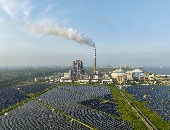
The United Kingdom has committed to reaching net zero carbon emissions by 2050. Carbon will be sequestered through a combination of methods: afforestation, bioenergy with carbon capture and storage. Energy will be produced by wind and solar farms instead of burning fossil fuels. But land is needed for all these activities, and loss of arable land will reduce agricultural production and increase agricultural imports, while sending the high-emissions problem to countries outside the U.K.
Just how bad is the U.K. carbon leakage problem, and will it get worse over time?
“Our research question was: how does land-based climate change mitigation in Great Britain affect land use and greenhouse gas emissions in the U.K. and globally?” said Sabrina Eisenbarth, Associate Professor of Environmental Economics at the University of St. Gallen. She was speaking at the webinar “Carbon Leakage” delivered on November 13, 2025, as part of the Virtual Seminar on Climate Economics (VSCE) organized by the Europe-based Centre for Economic Policy Research (CEPR).

She summarized research she co-authored with Brett Day, Alla Golub, and Uris Baldos. Brett Day is at University of Exeter; Alla Golub and Uris Baldos are at Purdue University. The article “Carbon leakage from land-based climate change mitigation measures” can be viewed online.
The researchers analyzed three scenarios for land-use change. The Natural Environmental Valuation (NEV), such as in a model developed by the University of Exeter, is a spatially and temporally explicit land use and energy model for Great Britain, on the one-square-kilometer grid. The map below shows the land-use change from three sources (arable, grass, mixed) to forest.

They counted financial costs of planting and managing, giving up agricultural output, and the GHGs associated with food production, as well as externalities like flood mitigation, water quality, pollination, etc.
To measure global effects and carbon leakage, they used the Global Trade Analysis Project (GTAP), which is widely used in the research community to study prospective international economic policy around issues of trade and climate. This classifies according to 18 agro-ecological zones (AEZ). Movement of land-use from one category to another is restricted according to the constant elasticity of transformation (CET) as shown in the following schematic.

How land is used changes gradually over time. They propagated their model in time using iterative linking in 5-year time steps.

The chart below shows land-use changes for all forms of climate change mitigation studied.

The researchers concluded that achieving UK forest planting and energy transition targets for NZE would reduce U.K. agricultural outputs and raise imports. Also, carbon leakage would undermine U.K. carbon sequestration.
More thought must be given to how to offset or prevent carbon leakage. ♠️
Graphs are derived from webinar slides. Permission pending.
The thumbnail cartoon is used with permission from Chris Madden.