

Nature risk, or the loss of natural assets, affects humans in a wide range of ways, but it is poorly understood, and its economic impact is not adequately measured. Yet it is gaining prominence during a time of concern about climate risk. The natural world helps mitigate climate change because it provides many natural sinks that absorb carbon dioxide, such as mangrove swamps.
“Nature is critical for us to get to net zero,” said Jo Paisley, president of GARP Risk Institute, referring to a fundamental goal of the 2016 Paris Agreement. “And climate change is one of the drivers of nature risk.” Paisley was speaking at a webinar titled “Nature Risk vs. Climate Risk: Is Your Firm Prepared?” on April 29, 2025, sponsored by the Global Association of Risk Professionals (GARP).

GARP has made progress in reporting climate risk and nature risk, starting from its first annual report on climate risk in 2019, to its first annual report on nature risk in 2024. GARP recently released its 2025 white paper on nature risk.
GARP risk reporting is done on financial firms and their counterparties. The climate risk of a financial firm is actually the climate risk of its counterparties. Rather than looking at the effect of flooding on the bank, they were looking at the effect of flooding on the manufacturers, farmers, and so on, that the bank lends to.
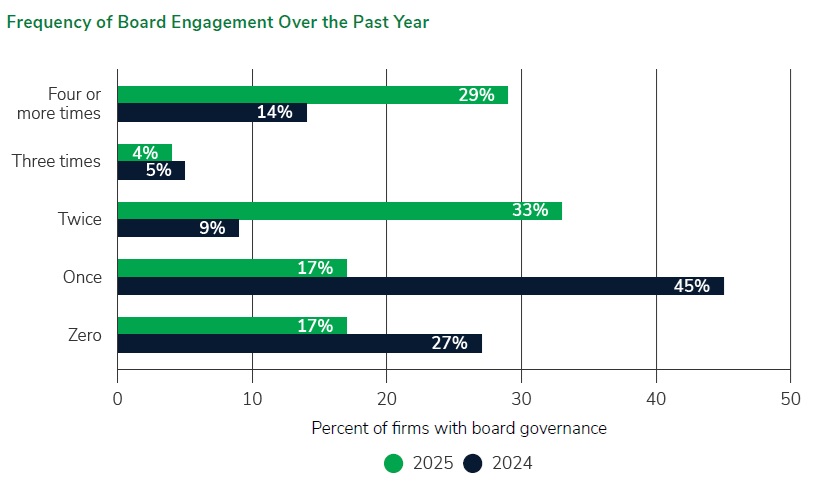
When it comes to integrating nature risk, Paisley suggested firms should start with governance, then look at strategy. She said the board oversight of nature risk is less advanced than board oversight of climate risk, with about half the firms responding that their board has governance over nature risk. The chief risk officer is most commonly named as the one overseeing nature risk at a firm.
“Has the firm assessed the risks and opportunities? Is it integrated in day-to-day risk management?” The survey done by GARP reported that company boards were discussing nature risk more frequently, compared to last year.
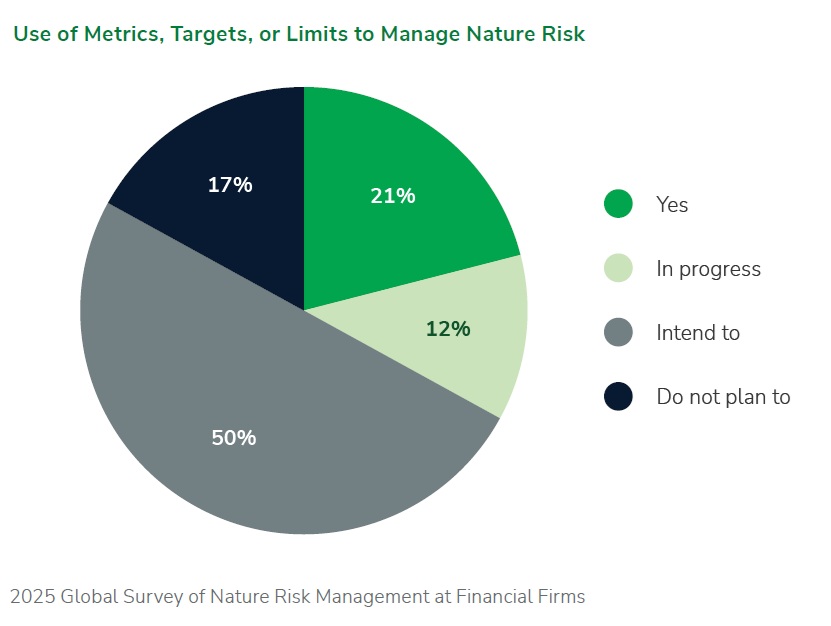
How about metrics, targets, limits? “We asked, ‘Does the firm use these to monitor nature risk and climate risk?’” Paisley said. “This helps us to assess the level of risk management maturity for these kinds of risks.” Only 17 percent of firms said they did not measure or intend to measure nature risk.
“Nature risk is not widely embedded in risk management at companies,” said the second panelist, Maxine Nelson, senior vice president of GARP Risk Institute. “We asked the question, ‘Does counterparty due diligence include nature risk or climate risk? Metrics are not yet well established, but firms that do use nature risk and strategy benefit.”
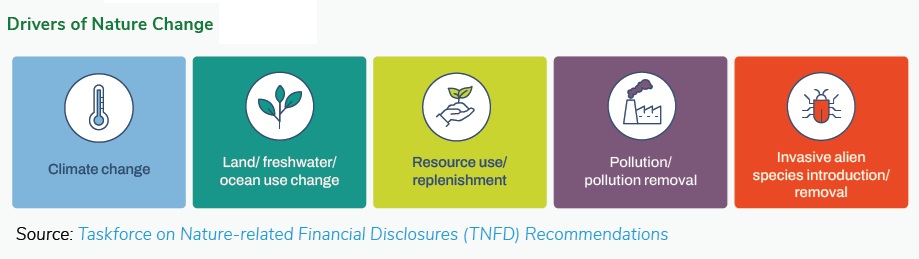
Paisley cited the five drivers of nature loss, as given by the Task Force on Nature-related Financial Disclosure (TFND):
- Climate change
- Change in land use or ocean use
- Resource use
- Pollution, and
- Invasive species.
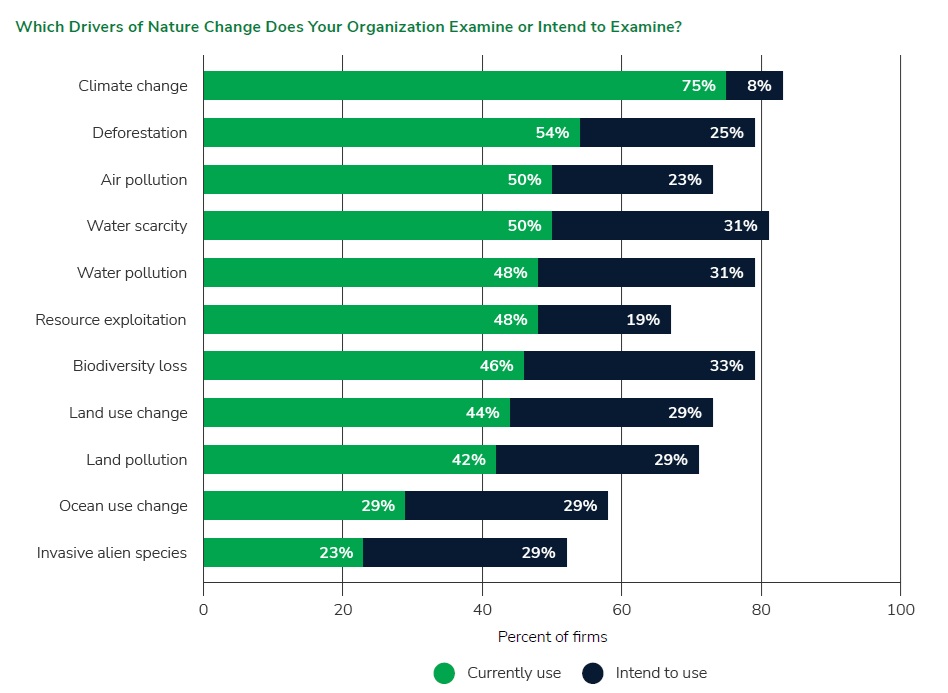
The GARP survey asked which drivers of nature risk firms measured, or intended to measure. Climate was the most commonly measured risk driver.
What concerns do firms have?
Nelson said that data and models dominate short-term concerns about measuring and reporting nature risk. Also, there is regulatory uncertainty. Firms expect more regulation in the future and thus, are “building capabilities through nature risk training. Some even allow all personnel to participate.”

“Regulatory focus on climate and nature has grown in the years from 2015 to now,” Nelson said. “We find nature risk lags by six to seven years behind climate risk.”
Interim governmental work on nature-related risk continues apace. “We have the Network for Greening the Financial System (NGFS), and the Organisation for Economic Co-operation and Development – Finance for Sustainable Development (OECD FSD),” she said.
Countries have different regulatory approaches. For example, European Union regulations differ significantly from those of Brazil.
Nelson did a brief survey of each country’s progress measuring nature risk for China, Hong Kong, and Japan. “We are seeing quite a range of how nature risk is taken into account.”
Gradually firms are “integrating nature risk-related risks into prudential frameworks. No one is yet expecting to hold tier one capital for nature risk,” she said. But it’s coming.
In summary, benchmarking has helped us understand where firms are. Governance, strategy and risk management processes are likely the first areas to be addressed. Then more quantitative aspects will come next. Regulation is key.
The natural world lies at the root of nations’ economies and the livelihoods of their citizens. As the world copes with climate change, we must not overlook the role of nature and, more broadly, the importance of preserving it.♠️
Click here to view the 2025 GARP white paper on Nature Risk and Climate Risk.
The graphs in this posting are from the 2025 GARP white paper.
Click here for GARP Risk Institute, the research and thought leadership arm of GARP.
The pictures in this posting of the mangrove swamps are by Dan Lundberg – https://www.flickr.com/photos/9508280@N07/40143596035/, CC BY-SA 2.0, https://commons.wikimedia.org/w/index.php?curid=111265803