
What are the best practices for environmental and climate risk management in the financial sector? Are the standard input scenarios actually suitable for financial modeling?
Economic scenarios are an essential tool in assessing the financial risks of the ever-changing world. Given that the average global temperature is increasing, and storms are becoming more severe, year over year, those who construct financial models of risk must set up new, realistic scenarios.
Estimating gains and losses on portfolios is difficult because of the deep uncertainty of climate impacts, but modelers must start somewhere. “Using relevant scenarios is crucial,” said Irene Monasterolo, Professor of Climate Finance at Utrecht University. She was delivering the webinar “Assessing the immediate materiality of climate risks: Insights from the NGFS short-term scenarios” on September 18, 2025. The presentation was part of the Virtual Seminar on Climate Economics (VSCE) organized by the Europe-based Centre for Economic Policy Research (CEPR).

First of all, what is the NFGS, and how significant is it? To foster collaboration among financial institutions in supporting the transition toward a sustainable economy, a group of banks founded the Network for Greening the Financial System (NGFS). The network has grown to include 114 central banks and financial supervisors.
Monasterolo divided the short-term risks into transition risk, which depends on investor perceptions, and physical risks, such as storms, wildfires and floods, which depend on cumulative emissions of greenhouse gases. “Outcomes in the next decade can vary widely due to tipping points.”
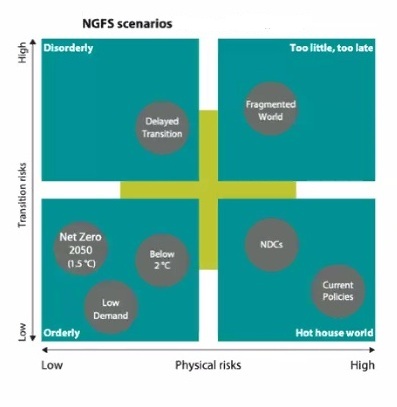
The NGFS graph of climate scenarios plots magnitude transition risk versus magnitude of physical risk (see below). The gray circles represent different scenarios, with the “Current Policies” scenario positioned in the quadrant marked “Hot house world.”
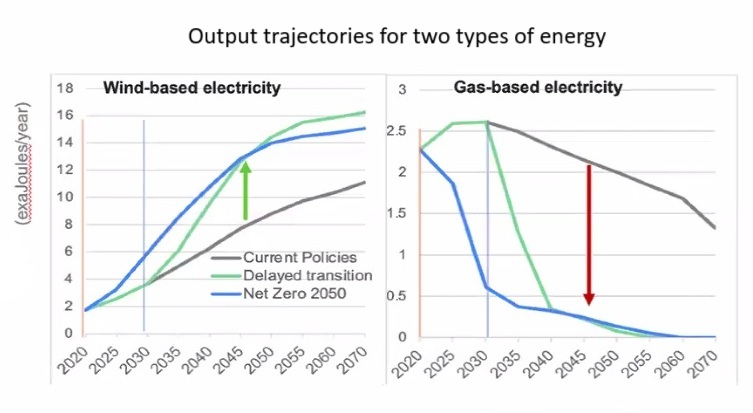
“The climate scenarios translate into output trajectories [over time] by type of energy technology,” she said. Below are two graphs, one for wind-based electricity, the other for gas-based. The different colors of lines correspond to three different scenarios (Current Policies, Delayed Transition, and Net Zero 2050).
As any scenario plays out over time, its trajectory will cause changes in valuation of a portfolio, which, in turn, affects firms’ cash flows and performance.
Monasterolo described a forward-looking approach to climate stress tests. Given a particular climate scenario, the risk manager translates it into probability of default, loss given default, and correlation for high-carbon and low-carbon bond issuers, to obtain the valuation adjustment.
Four Scenarios
NGFS recommends short-term climate scenarios (5-year horizon). She presented four different narratives:
- Highway to Paris (HWTP) – based on the Paris 2015 climate accord, carbon tax revenues are used for green investments. Orderly transition. Consistent preference of consumers and investors. Rising credit risks for high-carbon sectors.
- Sudden Wake-Up Call (SWUC) – sudden change in policy preferences. Consumer and investor preferences shift toward green sectors. Transition too sudden for markets to adapt, so there is lack of financial stability.
- Disasters and Policy Stagnation (DaPS) – Region-specific extreme events occur in 2026/2027 result in capital destruction, reduced productivity and lower production. Cascading economic impacts have trade and financial linkages.
- Diverging Realities (DiRe) – Advanced economies are on the HWTP path, but rest of world suffers extreme events. Effects occur via trade and financial linkage, supply chain disruptions in critical raw materials.
The scenarios are applied to give granular, bottom-up climate risk assessment (46 countries, 50 sectors) of compound risk and transition risk. The models allow spillover effects of both transition and physical risk through trade linkages, financial markets, and disrupted supply chains.
Compound Physical Risk
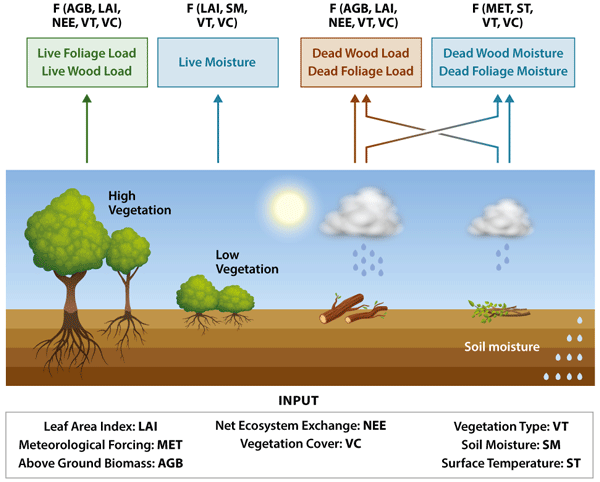
Monasterolo outlined some key novelties in the NGFS scenarios. One of the most striking is compound physical risk. The physical-climate storyline describes compound events, such as storms followed by floods, and heatwave-drought-wildfire sequences.
The coupled modelling framework has four key features:
- There is high granularity (country, sector, energy technology).
- It includes feedback effects of economic-financial dynamics.
- The risk is endogenous. Investors’ expectations adjust to policy and scenario.
- Adaptive expectations mean there is persistence of climate shocks on GDP and inflation in the short to mid-term.
Numbers can be crunched, but overall, there are limits to market-based approaches to climate risk assessment, and these ultimately make such approaches inadequate for decision-making.
However, through the work of Professor Monasterolo and colleagues, economists and financial risk managers are gaining a better understanding of risk transmission channels, and economic and financial feedbacks. ♠️
All graphics but one are derived from the webinar slides. Permission pending.
The heatwave-drought-wildfire graphic is from the European Geosciences Union website. Permission pending.