

To address environmental concerns, many governments impose pollution regulations on companies or firms. A key goal of such regulations is to spur the development of innovative clean technologies. Empirical evidence suggests that such strategies do, in fact, work.
But how effective are regional regulations when dealing with multinational corporations in a globalized economy?
“Environmental policies are often confined to local jurisdictions, whereas industrial production operates on a global scale. This mismatch poses a challenge for policymakers,” said Wei Xiang, Assistant Professor of Economics at the University of Michigan.

“Firms, especially multinationals, can move their pollution-intensive operations to foreign jurisdictions. This reduces their incentive to use clean technologies.” Xiang was presenting a webinar on October 2, 2025, as part of the Virtual Seminar on Climate Economics (VSCE) organized by the Europe-based Centre for Economic Policy Research (CEPR).
His research studied both the short- and long-term impact of pollution regulations on cleantech innovation when one production location can be substituted for another.
To acquaint the audience with his model variables, the schematic below shows the productivity at four locations. Two patents are compared. The blue line represents one patent (“Idea 0”) and the red line another patent (“Idea 1”).
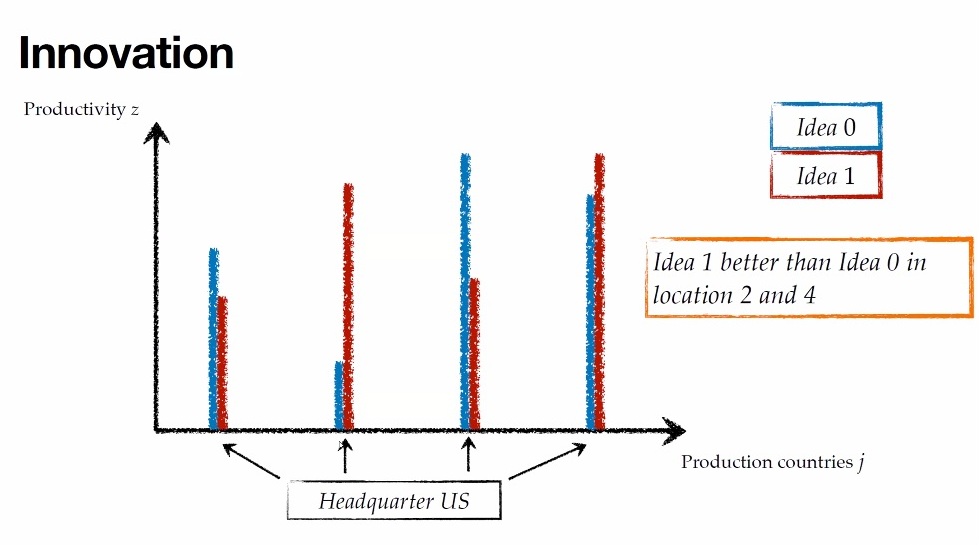
From this basis, Xiang developed a multi-country semi-endogenous growth model in which environmental policies have immediate effects on technology adoption (clean or dirty) and the choice of where to locate the production (e.g., build the factory).
Xiang used a comprehensive dataset and found that at the firm level, a higher number of clean technology patents is correlated with more stringent environmental policies.
However, the correlation is not as strong when a firm’s foreign production intensity increases.
Motivated by these empirical findings, he used the model to assess the global welfare implications of increasing environmental policy stringency in the European Union and the United States.
More information can be found in the research article; the link is given below. ♠️
Click here to view the VSCE webinar delivered by Wei Xiang, “Clean Growth and Environmental Policies in the Global Economy.”
Graphic is derived from webinar slide. Permission pending.
The thumbnail graphic is from NLPatent. Permission pending.