
How much can one person do against climate change? How much can one medium-sized nation do? Or, in the case of the European Union, a group of medium-sized nations?
“Climate change is a collective action problem,” said Jonathan Colmer, Associate Professor of Economics and Public Policy at University of Virginia. “Individual countries bear the cost of carbon regulation while the benefits are shared globally. The result is that too little climate change mitigation occurs.” He was delivering a webinar titled “The Global Effects of Carbon Border Adjustment Mechanisms.”

The presentation was based on a research article of the same title published at NBER and co-authored with Kimberly Clausing (UCLA), Allan Hsiao (Stanford), and Catherine Wolfram (MIT Sloan). Colmer’s webinar was part of the Virtual Seminar on Climate Economics (VSCE), a series organized by the Europe-based Centre for Economic Policy Research (CEPR).
Colmer introduced the aim of the European carbon border adjustment mechanisms (CBAM): “to realign incentives by taxing imports according to their carbon content. This will improve domestic competitiveness, reduce emissions leakage, and encourage carbon taxation abroad.”
However, one of the problems associated with the present form of policy, he said, is that “CBAM may disadvantage lower-income trading partners.”
The researchers found “there is limited evidence that industrial production in low-income countries is more carbon intensive. Chemistry is chemistry and the emissions intensity vs. income gradient is quite flat for the electricity sector.”
They carried out a quantitative analysis of European CBAM policies. Their model looked at the global equilibrium framework and micro data for five key industrial sectors.
As an example, he outlined the CBAM impact for a USD $100 European carbon tax (applied to the emission of one metric ton of greenhouse gases) as follows:
- Competitiveness. Domestic profits will increase by $1 billion.
- Leakage. Foreign emissions will decrease by 17 megatons.
- Incentives. The Chinese costs will decrease by $1.5 billion.
- Incidence. This will be similar for lower-income trading partners.
- Crowd-in. CBAM facilitates a Europe-China coalition by penalizing them financially if they do not regulate their carbon output, thereby “crowding in” the reluctant joiners.
Colmer noted that CBAM encourages other countries to join in CBAM, thereby lessening concerns about incomplete regulation. And it does so in a “distributionally neutral way.”
The environmental effects of trade policy have been studied before, using global equilibrium modeling. Colmer’s study used new facts and analysis focusing on plant level emissions and heterogeneity.
Policy design
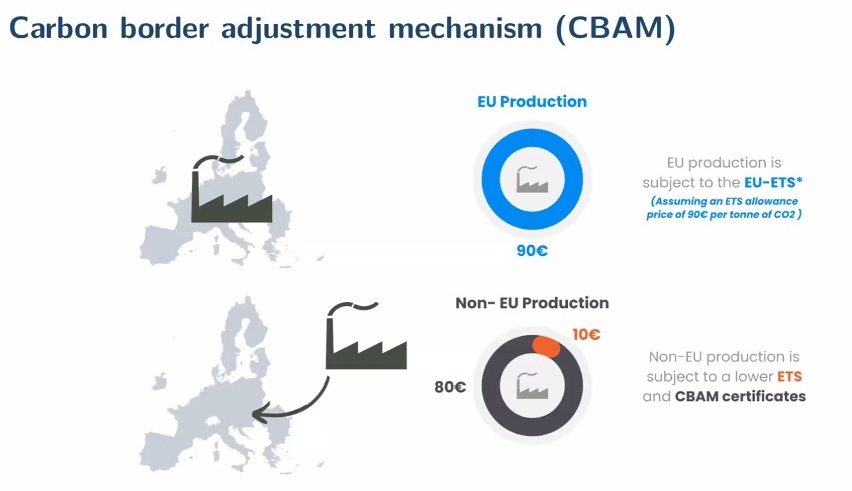
Increasing stringency of the European Union Emissions Trading System (ETS) and the European Green Deal policies raised concerns about incomplete regulation.
Under CBAM, importers have to purchase certificates at the ETS carbon price to cover emissions embedded in imports.
Importers are credited for any foreign carbon price that has already been paid.
The implication is that goods produced within and outside of the EU will face the same total carbon tax.
The EU CBAM was proposed in 2021 and implemented in January 2026 for target sectors. There will be expansion of the Chinese Trading Price System (TPS) to target sectors.
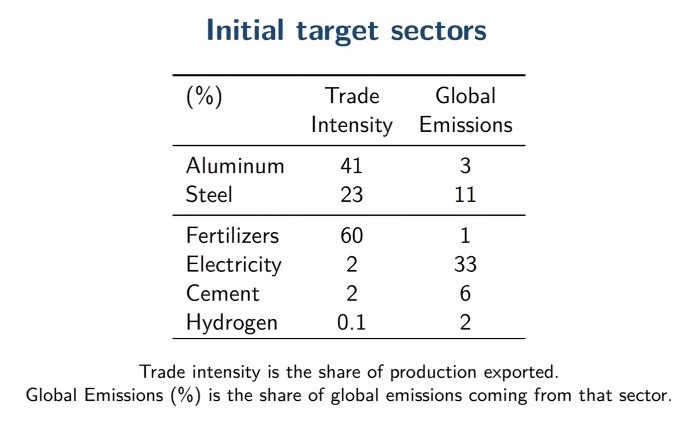
The initial target sectors are aluminum, steel, fertilizers, electricity, cement and hydrogen.
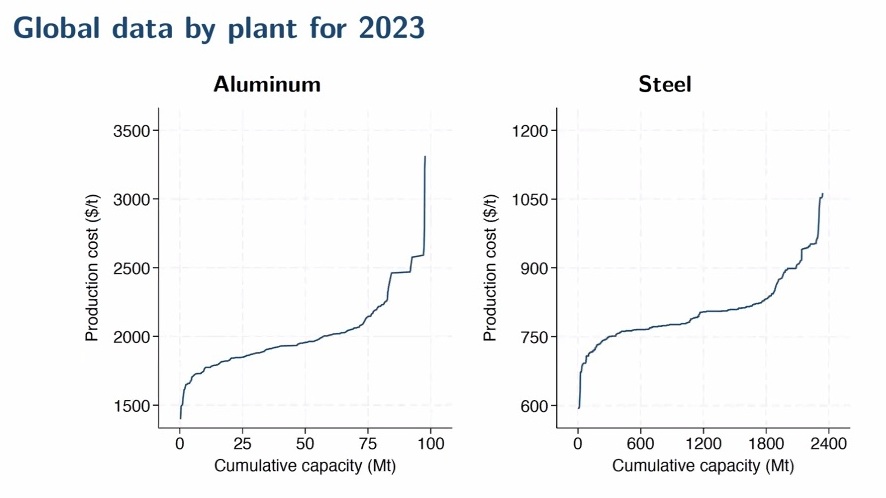
Global data by plant has been available since 2023 for these sectors. The graph below shows an example of production cost as a function of cumulative capacity for aluminum, and for steel.
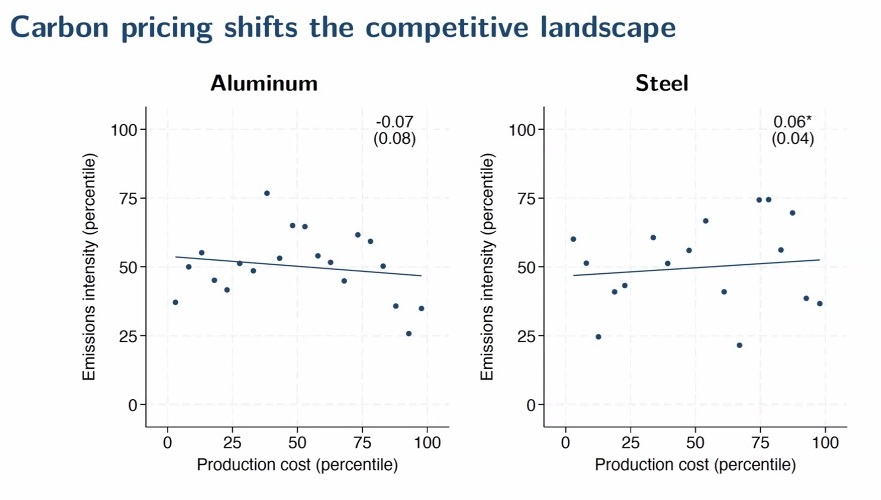
Carbon pricing shifts the competitive landscape. The graph below shows the shift for the same two sectors.
Summary
The researchers showed quantitative equilibrium analysis of European CBAM policies successfully curbed emissions leakage and boosted domestic competitiveness, while avoiding disproportionate economic burdens on lower-income trading partners.
Furthermore, domestic advantages may help both to establish carbon regulation in the first place and, second, to sustain international coordination.
More information can be found in the research article; the link is given below. ♠️
Click here to read “The Global Effects of Carbon Border Adjustment Mechanisms,” published by the National Bureau of Economic Research (NBER), coauthored by Kimberly Clausing, Jonathan Colmer, Allan Hsiao, and Catherine Wolfram.
Click here to view the VSCE webinar at the CEPR website.
Graphs & thumbnail are derived from webinar slides. Permission pending.