
The Iran-Israel-U.S. War in the Persian Gulf and the Strait of Hormuz continues to send the price of oil soaring. Given the recent rise, what is the economic benefit to a country such as Canada, a net exporter of oil?
This was the question posed by three economists writing in the September 30, 2026, Economic Newsletter of the Federal Reserve Bank of San Francisco (FRBSF). Author Thuy Lan Nguyen is Research Advisor at the Economic Research Department of the FRBSF. Wataru Miyamoto is Associate Professor, University of Hong Kong, and Dmitriy Sergeyev is Associate Professor, Bocconi University.
Canada is one of the world’s largest producers of oil, reaching 311 million cubic metres, and exporting 250 million cubic metres in 2025. The first guess might be that Canada benefits from supply shocks.
Guess again.
“Our analysis of key Canadian industries suggests that the net negative effects on the oil supply dominate the positive effects on the oil industry,” the researchers write.
In general, they write, “an adverse oil supply shock raises energy prices and increases production costs globally, often leading to a contraction in economic activities alongside elevated inflation.”
When a major event occurs, the oil shock it causes will propagate through an economy over time. (Exact details may be found in the paper by Wataru et al.) In Figure 1, results from two economies are shown: Canada, the oil exporter (solid blue line is the mean), and Europe, a large net oil importer (solid red line).
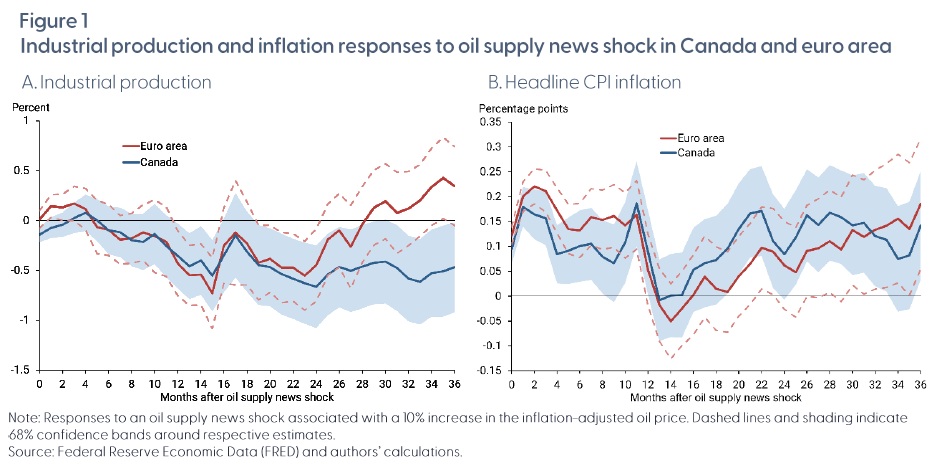
Panel A shows a dip in industrial production for 2 to 3+ years following an oil supply shock. Europe recovered sooner, at about 28 months, whereas Canada struggled to return to previous levels even at 36 months.
“Industrial production falls in both economies after an adverse oil supply news shock,” they write.
Panel B shows Consumer Price Index (CPI) inflation rose almost immediately by 0.1 percent and stayed high for a year. “The overall effects on headline inflation are similar for both of these economies,” they write.
But why didn’t the oil shock benefit Canada? The researchers had to parse the data further to understand why.
They found “other economic activities in Canada suffer from oil supply disruptions” and this was why, overall, the oil shock was bad news.
Figure 2 shows two economic sectors: Panel A, energy-related in and Panel B, manufacturing related. The red and blue lines denote two different time periods.
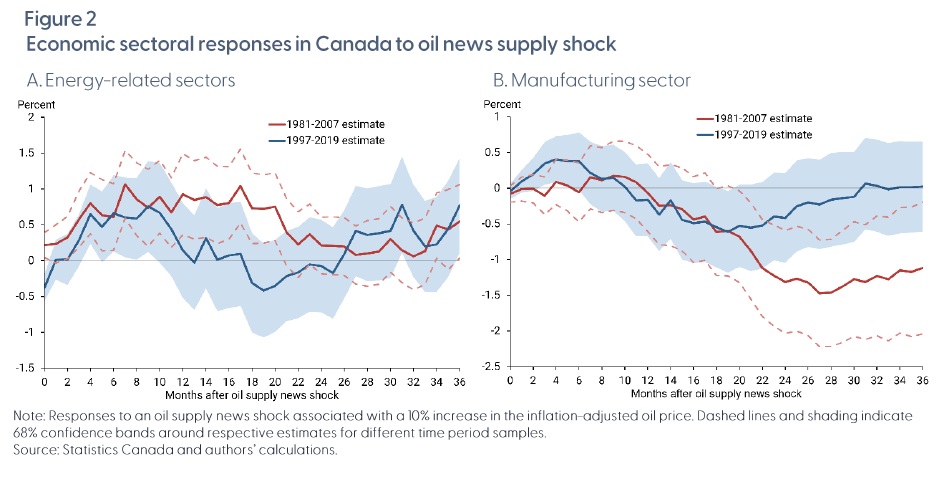
“Energy-related sectors (mining and oil and gas extraction) increase up to 1% after an oil supply news shock.”
In Panel B, the “manufacturing sector (not including mining/oil and gas extraction) declines.”
“Since the oil and gas industry accounts for a small fraction of Canadian GDP, the positive impact in the energy-related sectors cannot offset the negative shock to the rest of the economy,” they write.
They conclude, “Although Canada gets some positive wealth effects that help offset the economic costs of higher oil prices, the oil extraction industry in Canada only represents about 5% of its GDP, and therefore, it is not large enough to offset the negative effects of higher oil prices on the rest of the economy.” ♠️
FRBSF Economic Letter: Click here to read “Effects of Oil Supply Disruptions on Oil Exporters, Importers” by Wataru Miyamoto, Thuy Lan Nguyen, and Dmitriy Sergeyev.
Figures 1 and 2 are reproduced from the Economic Letter. Permission pending.