

Remember when the top economic news was a softening in demand for consumer goods? Recent data from the markets suggest there’s been a sea change in the economy.
“After two decades of concerns primarily about changes in demand, the stock-bond correlation recently flipped,” reports an economic newsletter published on August 10, 2026. The source of risk to the economy has shifted from demand shocks to supply shocks.
The newsletter was co-authored by Thomas M. Mertens, senior vice-president and associate director of research, Economic Research Department of the Federal Reserve Bank of San Francisco (FRBSF), and Wesley Wasserburger, research associate, also in the Economic Research Department of FRBSF.

A decrease in supply of physical goods lowers economic activity (imagine an automaker waiting for parts) and lowers stock valuations (imagine the automaker becoming unable to make sales). This raises inflation. The market price of bonds (issued by the automaker) drops. Bond yields, which are inverse to bond price, increase.
“A positive stock-bond correlation is associated with … demand shocks,” they note, referencing the landmark 2020 paper by Campbell, Pflueger, and Viceira, whereas “a negative stock-bond correlation occurs when supply shocks are the primary source of risks to the economy.”
The chart of data below, based on Standard & Poor’s 500, shows this change in correlation. “In line with the negative stock-bond correlation, the 1990s marked a transformative era in information technology, leading to significant investment,” Mertens and Wasserburger write.
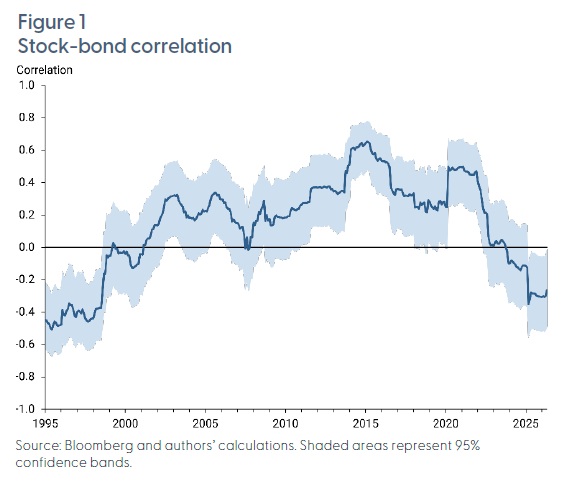
“The reemergence of supply-side risks due to the pandemic, swings in immigration, changing tariff policies, and disruptions to energy markets… led the stock-bond correlation to change to negative … in the early 2020s.”
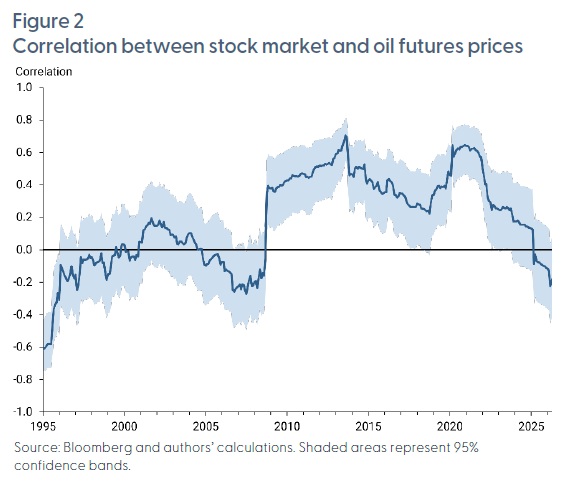
Next, they looked at oil prices and supply-side risks. “The stock market’s correlation with oil futures prices broadly mirrors the … stock-bond correlation.” This is shown below in Figure 2.
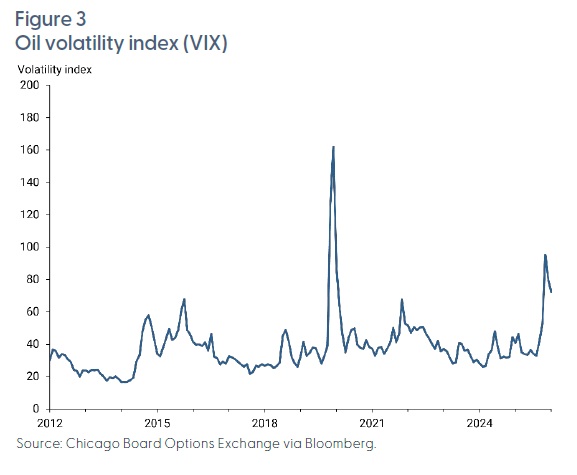
As anyone paying bills for heating or cooling knows, fluctuation in energy prices is a big risk, so the authors looked at a market-based measure of oil price uncertainty, the Chicago Board Options Exchange Crude Oil Volatility (Oil VIX). Two peaks appear, one at the start of the pandemic, and another at the start of recent conflict in the Middle East.
Mertens and Wasserburger looked at the correlation of Oil VIX with the price of oil futures and found that “increased uncertainty around the oil market is now associated with higher oil prices, whereas it used to coincide with lower prices.”
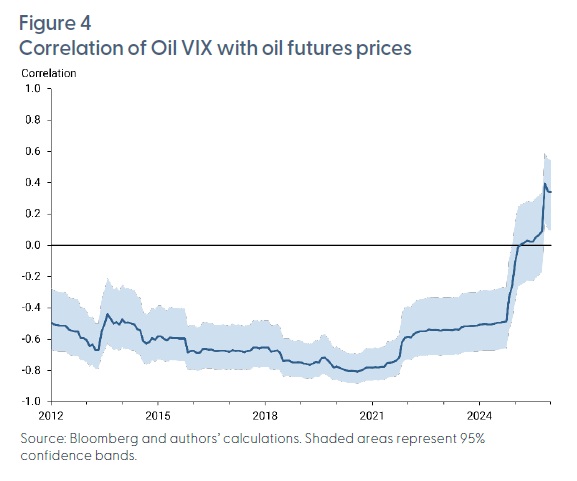
“Consequently, policymakers may face more frequent supply shocks,” they write, “as well as an uncomfortable combination of elevated inflation with softer economic activity in the near term.”
Buckle up for a bumpy ride! ♠️
FRBSF Economic Letter: Click here to read “Financial Markets, Oil Prices, and Supply-Side Risks” by Thomas M. Mertens and Wesley Wasserburger.
Figures 1-4 are reproduced from the Economic Letter. Permission pending.
The thumbnail photo of oil derricks is by Documerica on Unsplash.