
Climate change affects, and will continue to affect, agricultural productivity around the world. It is one of the inescapable ironies of our times that sub-Saharan Africa will be severely affected by climate change, despite how little it has contributed to global carbon emissions.

How severe will these effects be? And is there any way to mitigate the effect on the most susceptible nations, besides curbing emissions, which appears to be a losing strategy?
“Agriculture is a vulnerable sector because it is fed by rain and it is near the limits of thermal tolerance to begin with,” said Obie Porteous, Associate Professor of Economics, Middlebury College. He was speaking at the webinar “Agricultural Trade and Adaptation to Climate Change in Sub-Saharan Africa” on September 4, 2025. The presentation was part of the Virtual Seminar on Climate Economics (VSCE) organized by the Europe-based Centre for Economic Policy Research (CEPR).

He used historical yield data (1981 to 2010) from the GAEZ database, short for Global Agro-Ecological Zones, developed by the Food and Agriculture Organization (FAO) of the United Nations. GAEZ is a modeling framework and data portal widely used to plan sustainable land use and agricultural development.
From this, he generated a picture of agriculture in the future period 2071 to 2100.
Surveying 24 countries in the sub-Saharan region, he found heterogeneity and change in the average yield. Crops like potato, onion, sugar cane and barley had yield declines of approximately 70 percent due to climate change in 16 of the 24 countries.
It was not all bad news. In eight of the 24 countries, yields of crops like sweet potato and millet were up between 30 to 40 percent.
(See map below for climate change yield effect by market catchment area.)
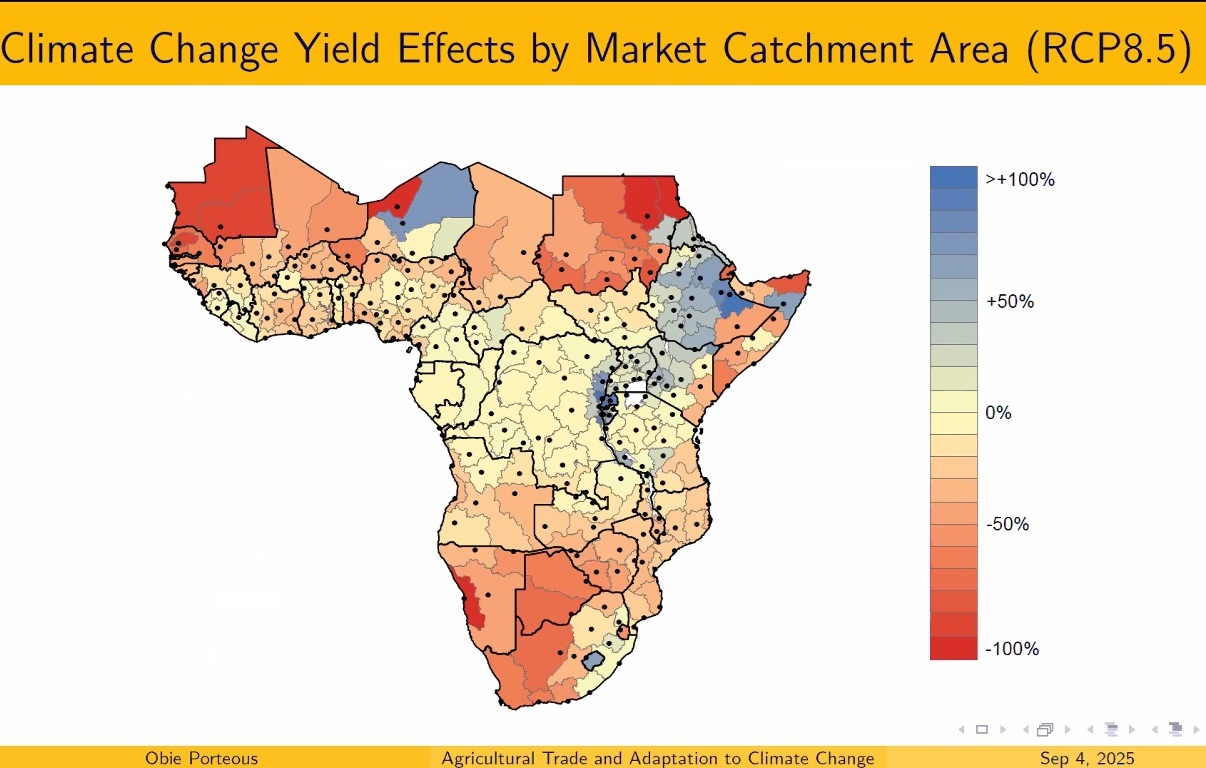
NOTE: This map was generated using the “RCP 8.5 scenario,” frequently referred to as the “business as usual” pathway. The acronym Representative Concentration Pathway (RCP) is a prescribed pathway for greenhouse gas concentrations, land use, and other factors used by climate models to project future climate outcomes.
Porteous said, “I found effects in 24 nations of sub-Saharan Africa are expected to be larger than in most other nations.” Moreover, “these changes will have greater knock-on effect due to how strongly African economies depend on climate.”.
“I estimated a continent-wide welfare loss equivalent to 4.8 percent of GDP under existing high trade costs, with country-level losses up to 43.8 percent of GDP.”
On a country-by-country basis, climate change effects were found to be large, heterogeneous, and uncertain. They ranged from a drop of two percent of GDP all the way to a drop of 60 percent in Niger and 52 percent in Rwanda.
Next, Porteous asked the question: could trade between regions offset the impairment?
He used his previous sub-Saharan trade model from 2019 as part of the study to estimate the costs of transportation, based on types and distances, and included 41 ports with port-specific trade costs.
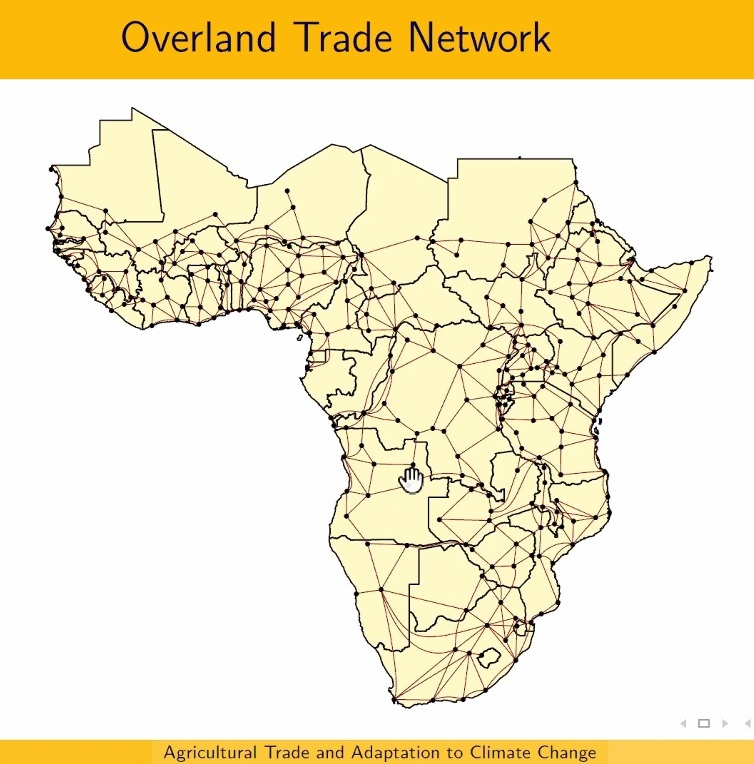
He considered two alternative approaches to investigate the role of trade in adaptation to climate change, basically, free and restricted trade. More details can be found in the article.
His model showed that lowering trade costs can help, both to adapt to and offset climate change.
As Porteous wrote in conclusion, “the role of trade in adapting to the increased frequency of extreme weather events and other short-term supply disruptions is an important topic for future research.” ♠️
Graphics are derived from webinar slides. Permission pending.
The thumbnail graphic is from Christian Science Monitor. Permission pending.