

Environmental protection seems to come and go, depending on the whim of the party that gets voted into office. A citizen might wonder, how is climate policy designed, anyway? Is there a method to the madness?
New climate policy is developed through an iterative process that blends scientific data, public consultation, and political negotiation to meet long-term net-zero goals. Effective design usually combines “carrots” (tax credits, rebates, etc.) with “sticks” (carbon pricing, fines, etc.) to accelerate the transition.
“Fighting climate change requires implementing ambitious carbon reduction policies,” said Thomas Bourany, postdoctoral research scholar of economics at Columbia University. “The free-rider problem is what causes climate inaction.”

He was presenting the webinar “The Optimal Design of Climate Agreements” on March 5, 2026, as part of the Virtual Seminar on Climate Economics (VSCE), a series organized by the Europe-based Centre for Economic Policy Research (CEPR). His research appears among papers at the 2025 European Central Bank (ECB) Forum.
Climate policy redistributes wealth across countries, which have great differences in GDP, climate damage, and energy markets. The problem is that individual countries have no incentives to implement globally optimal policies that do not benefit themselves.
Also, there is the problem of carbon leakage, where production and emissions move to nations with lower environmental protection.
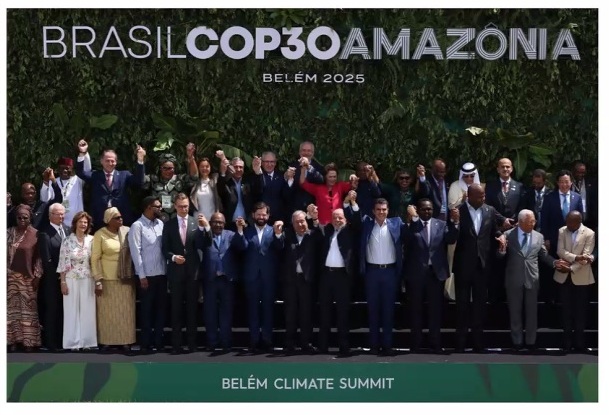
There are proposals to fight climate inaction through international cooperation and climate agreements such as the U.N.’s Conference of Parties, most recently COP 30, that occurred in Belém, Brazil, in November 2025.
“Our paper looks at how we can design a climate agreement to address the free rider problem and endogenous participation,” he said, “as well as redistributive effects.”
“Trade sanctions are needed in order to give incentives to countries to reduce emissions,” Bourany said. He cited the landmark 2015 paper by William Nordhaus, who suggested the answer is to set up a climate club. The agreement boils down to the choice of member countries that will implement a carbon tax and, for those countries that are outside of the club, charging tariff rates on goods and energy.
Bourany drew a distinction between an “intensive margin” (a climate club with few countries and large emission reductions) versus an “extensive margin” (a club that contains a broader set of countries but does has smaller emission reductions). There is a trade-off between the two.
In this paper, Bourany built a “rich Integrated Assessment Model (IAM) with heterogeneous countries, energy markets, international trade and countries’ strategic behaviors.”
The results, he found, were mixed. “There is the ‘impossibility result.’ In other words, because of free riders, we cannot achieve both a high carbon tax and complete participation despite arbitrary trade tariffs.”
He referred to the economic concept of Pigouvian tax. This is a tax on a market activity that generates negative externalities. For example, the tax on cigarettes is meant to internalize the societal costs (healthcare strain) caused by the use of these products. He said, “The optimal club design means we need to lower the carbon tax below the Pigouvian benchmark.”
“We have to impose large trade tariffs for non-members. Also, we have to leave several fossil fuel producers outside the agreement.”
Bourany laid out the “rules of the game” for design of climate agreements and certain equilibrium concepts. He aimed for a Nash equilibrium, a concept from game theory. A Nash equilibrium exists if each player has chosen a strategy and no one can increase his own expected payoff by changing his strategy while the other players keep theirs unchanged.
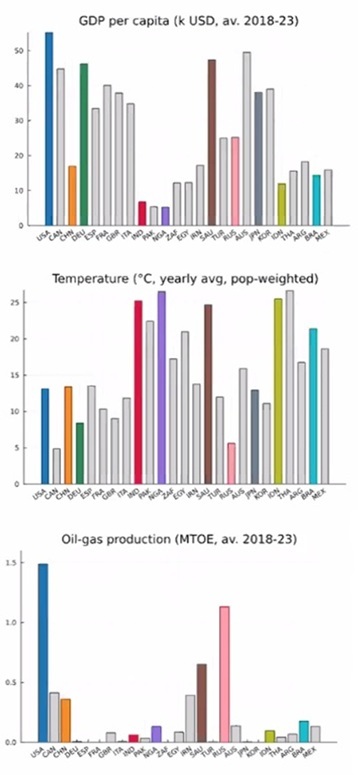
This is a tall order, considering the variation across countries in GDP, average temperature, and oil & gas production. The figure below shows these quantities for the 2018-2023 period. (The bottom axis lists the countries in no particular order. For ease of reference, some countries histogram bars are colored (blue for U.S., orange for China, green for Germany, red for India, brown for Saudi Arabia, pink for Russia, grey for Japan, lime-green for Indonesia, and bright blue for Brazil).
“While a universal agreement with globally optimal carbon taxation may be unattainable due to free-riding incentives and redistributive effects, carefully designed climate clubs with strategic use of trade policy can achieve significant progress in global climate action,” he noted.
He concluded, “the optimal climate club includes all countries except Russia, with a moderate carbon tax of $100 per ton of CO2 and a 50 percent tariff on goods from non-participants.”
Bourany showed a 3D plot of participation as a function of the 2D carbon tax versus tariff rate.
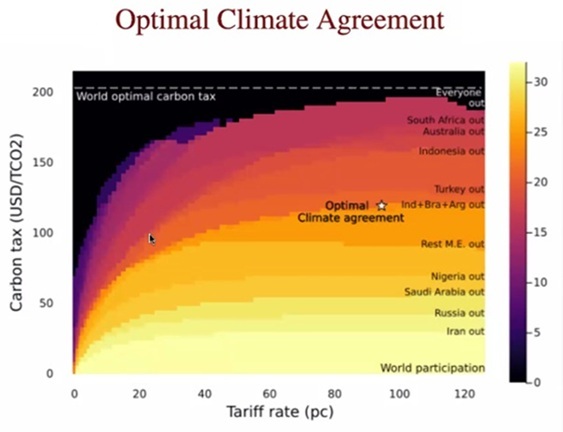
The optimal climate club cannot sustain an agreement with Russia, Middle East, South Asia and South America. It will be beneficial to leave several fossil-fuel producers outside the agreement. For example, there is no incentive for Russia to join. It is cold, closed to trade and is a large fossil-fuel producer.
However, the second-best model may be preferable. He said, “to increase participation, it is beneficial to reduce the carbon tax by 35 percent from the globally optimal level of $150 per ton of CO2. This allows for the inclusion of Middle Eastern countries and several developing economies in South Asia and Africa.”
Details of his model can be found in the research article at the link given below. ♠️
Click here to access the paper by Bourany and co-workers: “Climate Policy.”
CEPR link: “The Optimal Design of Climate Agreements”
Click here to access other VSCE webinars.
Graphs & COP30 photo are derived from webinar slides. Permission pending.