
In developing countries, many households, even those where adults work in non-agricultural sectors, depend on small farms for food and income. These farms operate at a lower rate of productivity, unable to benefit from economies of scale.
Typically, these households are uninsured against negative income shocks. What happens, then, when weather shocks occur, such as heat waves or drought?
Economic researchers recently studied the link between small farms and income shocks in Colombia, a country of 52 million, with one-tenth the land size of the U.S.
 “We found that temperature shocks increased the number of land sales and mortgages, with most land buyers coming from other regions or sectors,” said Heitor Pellegrina, Assistant Professor of Economics at University of Notre Dame.
He was presenting the webinar “Farm Size Distribution, Weather Shocks, and Agricultural Productivity” on February 19, 2026, as part of the Virtual Seminar on Climate Economics (VSCE), a series organized by the Europe-based Centre for Economic Policy Research (CEPR). The research appears in the journal Borradores de Economia.
“We found the owners resorted to selling parcels of land in order to supplement the household income. These distressed land sales mean farms are kept small and agricultural productivity is kept low.”
Data
In evidence-based economic research, the quality of data is key. This research project depended on detailed information about land, land sales, and weather, over time.
Notarized land sales over the years 2000 to 2011 provided the data on transactions. In Colombia, there are about 400,000 land plots, he noted. Cadastral land registries over the same period provided farm sizes for 927 municipalities.
Longitudinal survey data focused on small landholders (Encuesta Longitudinal Colombiana de la Universidad de los Andes, ELCA) for the years 2010, 2013 and 2016.
As well, the researchers surveyed 151 rural community leaders representing 7000 farmers across 30 municipalities.
They constructed weather shock variables based on temperature information from ERA5 data, which is provided by the Copernicus Climate Change Service (C3S) of the European Centre for Medium-Range Weather Forecasts (ECMWF).
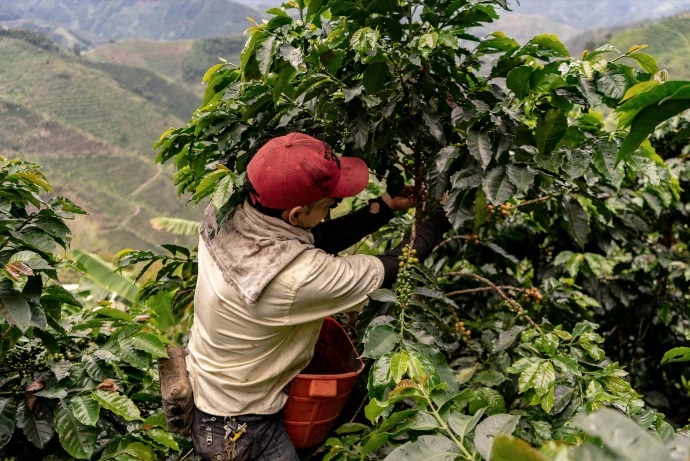
Rural land markets in Colombia
A natural question is whether crop insurance is available to protect farmers from bad years. Unlike North America, Colombia has extremely low adoption of agricultural insurance, less than 1 percent.
Survey data indicate there are frequent distressed land sales; 65 percent of households that sold their land reported problems with household debts.
Land rental markets are thin. Ownership is strongly associated with operation of farms; 85 percent of plots are operated by the owners and only 9 percent operate on rented land.
Methodology
The economists used a dynamic heterogenous-agent model to construct a logical explanation for data and results that have been gathered through years of direct observation.
The model’s features included choice of occupation and sector-specific productivity shocks.
Findings
Using the model, the researchers were able to study the response of the Colombian economy to a single weather shock and to a sequence of shocks.
Heat shocks put downward pressure on farm size. “Effects concentrated in the left tail of the farm size distribution,” Pellegrina noted.
They found a single shock reduced farm size and took a long time to fade out, as shown in the graph below.
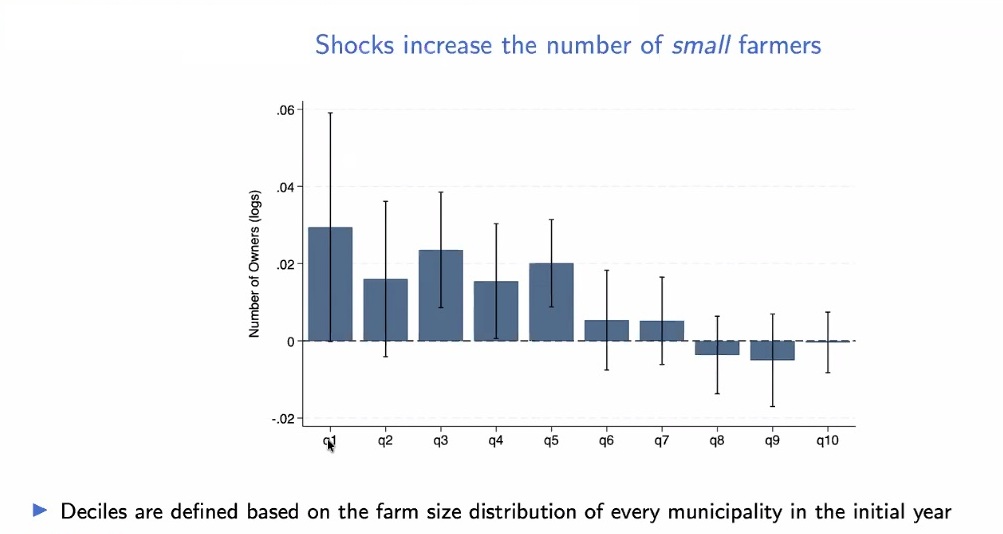
Even small changes in the probability of a temperature shock produced large effects on the output per worker.
However, the effect of heat shocks on fragmenting farms is less pronounced in Colombia than in some other nations. Pellegrina showed a graph (below) to place their observations in context with other research on other countries.
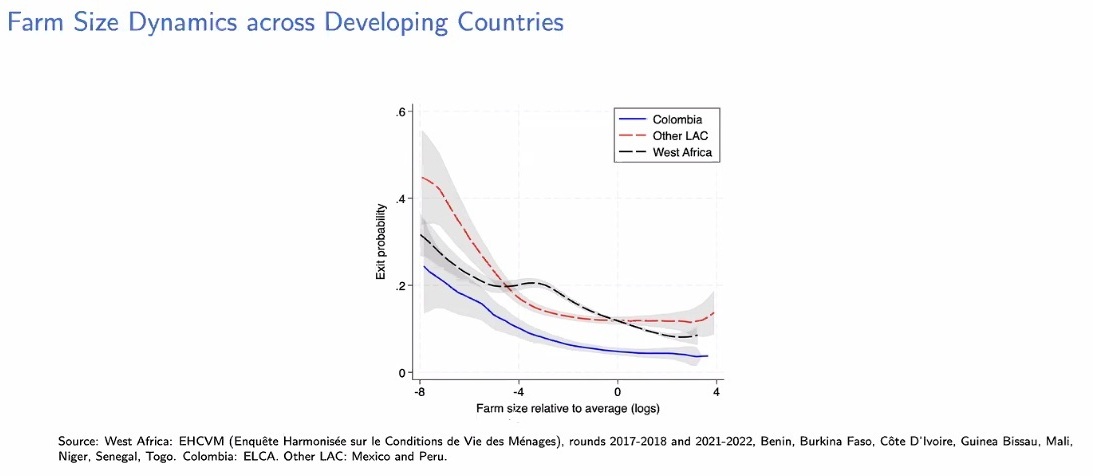
The relationship between weather shocks and farm size is not good news, Pellegrina said, because “extreme weather disruptions are expected to increase in number and severity due to climate change.”
More information can be found in the research article at the link is given below. ♠️
CEPR link: “Farm Size Distribution, Weather Shocks, and Agricultural Productivity”
Link to paper: “Farm Size Distribution, Weather Shocks, and Agricultural Productivity” in Borradores de Economia. Joint work with Julián Arteaga, Nicolás de Roux, Margarita Gáfaro, Ana María Ibáñez, and Heitor S. Pellegrina
Click here to view the Youtube recording of Professor Pellegrina’s CEPR webinar.
Click here to access other VSCE webinars.
Graphs are derived from webinar slides. Permission pending.
The thumbnail photo of small farms in Colombia is from Wikipedia. This file is licensed under the Creative Commons Attribution-Share Alike 2.5 Generic license. Attribution: Luiseduardo.bernal