
Supply chain disruptions during the pandemic made average citizens aware of how vulnerable supply chains are, and how severe the knock-on effects can be. Supply chains continue to be exposed to risk in many ways: geopolitics, labour, and weather, to name a few.
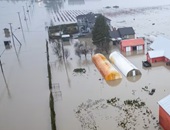
In this month alone, floods and atmospheric rivers have caused major disruption of supply chains, such as can be seen in the December flooding in British Columbia’s Fraser Valley and Washington state.
As companies continue to manage supply chains in the face of climate change, what are the trade-offs between cost minimization and resilience? What are the resulting impacts on wages and economic welfare?
“Supply chain disruptions have become a key concern for firms and policy makers,” said Juanma Castro-Vincenzi, Assistant Professor of Economics at the University of Chicago. “Extreme weather disruptions are expected to increase in number and severity due to climate change.”

He was presenting the webinar “Weathering the Storm: Supply Chains and Climate Risk” on December 11, 2025, as part of the Virtual Seminar on Climate Economics (VSCE), a series organized by the Europe-based Centre for Economic Policy Research (CEPR).
He referred to the study by McKinsey, “Could climate become the weak link in your supply chain?” that shows the increase in disruptive events over the past two decades.

“How, then, do firms adjust their supply chains to accommodate climate change?” Castro-Vincenzi summarized research he co-authored with Gaurav Khanna at the University of California, San Diego, Nicolas Morales at the Federal Reserve Bank of Richmond, and Nitya Pandalai-Nayar at the University of Texas at Austin.
They studied India, which had granular data available for productivity and weather (temperature and precipitation). The dataset was “a new universe of firm-to-firm transactions.” For computational feasibility, the researchers gathered “the 600-plus districts in India into 271 regions by grouping contiguous low-population districts” and calibrated their model to these 271 super-districts.

Firms are under constant pressure to build a supply chain that is resilient but is not too costly, so the researchers analyzed the data in low- to high-risk locations, looking for patterns in wages, aggregate output, volatility, and welfare.
On the theoretical level, Castro-Vincenzi asked, “What are the spatial general equilibrium effects of firm-level supply chain adaptation?” To do this, they studied patterns for wages, aggregate output, volatility, and welfare in risky locations vs safer locations.
He noted, “There are two types of goods: tradeable intermediate goods and non-tradeable final goods.” They used a quantitative model of sourcing under uncertainty that considered both types.
Their study brought in new facts on firm sourcing they had from the Indian state. Many firms multi-source their inputs from further drier regions at higher prices. They studied an event such as responses to large floods and found there was a short decline in inputs. No change in suppliers.
Not surprisingly, the probability of disruption was positively correlated with rainfall, flooding, and temperature. The researchers found supply chain diversification. Firms traded the input costs and sourcing risk in order to have supply chain resilience.
The study was significant because they quantified the model using several granular sources of data, and found descriptive patterns in the data consistent with the theory.
They concluded that firms’ sourcing responses played a dual role: on the one hand, diversification reduced the impact of climate risk on aggregate welfare, mainly by reducing output volatility.
On the other hand, the adaptations intensified spatial inequality. The regions most exposed to climate shocks also experienced declines in real wages.

“Supply chain adaptation offers macroeconomic resilience,” Castro-Vincenzi said, “but can amplify differences in regional outcomes.”
More information can be found in the research article; the link is given below. ♠️
Click here to access the paper, “Weathering the Storm: Supply Chains and Climate Risk.”
Click here to view the recorded webinar, “Weathering the Storm.”
Click here for a related video of Prof. Castro-Vicenzi describing climate risk and supply chains.
Click here to access other VSCE webinars.
Graph & map are derived from webinar slides. Permission pending.
The photo of flooding in Abbottsford, B.C. in December 2025 is from CBC News. Permission pending.