
Who owns the environment? Who has the right to pollute the environment?
Climate policy is essentially a negotiation over who owns the environment and the allocation of economic, technological, and developmental costs and benefits among nations. Yet, how should we determine the fairness of this distribution? The economic analysis of climate change is a broad and growing area.
“A central debate in international climate policy is the distributional consideration,” said Simon Lang, a postdoctoral researcher in the Sustainability Economics Group at ETH Zurich. He was presenting a webinar on April 2, 2026, as part of the Virtual Seminar on Climate Economics (VSCE), a series organized by the Europe-based Centre for Economic Policy Research (CEPR).
The webinar, cryptically titled “Coase Meets Negishi” sent us on a quick refresher to see what these terms mean.
Some Background
The Coase theorem argues that private parties can resolve externalities (like pollution or noise) on their own through negotiation, provided transaction costs are low, and property rights are clearly defined. It means the final, efficient outcome is independent of who is initially given legal rights.
For example, if a factory pollutes a river, harming the people who fish:
- If the people who fish have the right to clean water: The factory will pay the fisher for the right to pollute (up to the amount the factory makes from that pollution).
- If the factory has the right to pollute: The people who fish will pay the factory to reduce production (up to the amount the people would lose from pollution).
- Outcome: In both scenarios, they reach the same optimal amount of pollution. This is the Coase outcome.
The second half of the webinar title, Negishi, refers to the welfare weights that are assigned. The Negishi social welfare function recognizes and embeds into economic analysis a varying and unequal price of life across different countries. It is used in the Kyoto Protocol and other macroeconomic analyses.
Current Analysis
Lang described his approach as “Coase meets Negishi” because it connects two schools of economic thought. “We are extending the logic of the Negishi theorem to a setting with public goods.“
A property rights perspective on distributional effects of climate change would separate the issues of climate change and global income inequality. But, as Lang pointed out, “there is no unique way to separate climate change and global inequality.”
“The standard approach to optimal climate policy sidesteps distributional considerations,” he said. Two questions arise:
“Who should pay?” and
“Do polluters have the right to pollute?”
Lang tried to show how different ways of looking at property rights, ranging from “right to pollute” to “right to no pollution,” rationalized different welfare weights in climate-economic models with heterogeneous regions.
Lang’s research, carried out with Matthew Kotchen (Yale University), and Matthew Gordon (Paris School of Economics), consisted of a model that used calibrated simulations to illustrate the distributional implications of different property rights regimes. They ran simulations using the updated and modified version of the C-DICE model (by Nordhaus, 2015). The global social cost of carbon was exogenously set to $213 per ton of CO2, the U.S. EPA estimate for 2023.
The maximization of a Negishi-weighted social welfare function yields the competitive equilibrium for given endowments of private goods.
In their model they set up different climate endowments, referred to as benefits and damages. They gave country-specific benefits from emitting pollution, and country-specific damages from having to cope with pollution.
“Property rights imply a reference allocation,” Lang said. “They do not pin down unique efficient allocations. The right to pollute gives a Nash equilibrium, which would lead to inefficiently high emissions. The right to no pollution would mean zero emissions, which would be inefficiently low.”
He went into detail about the Nash bargaining solution, where two parties must bargain to obtain an efficient allocation.
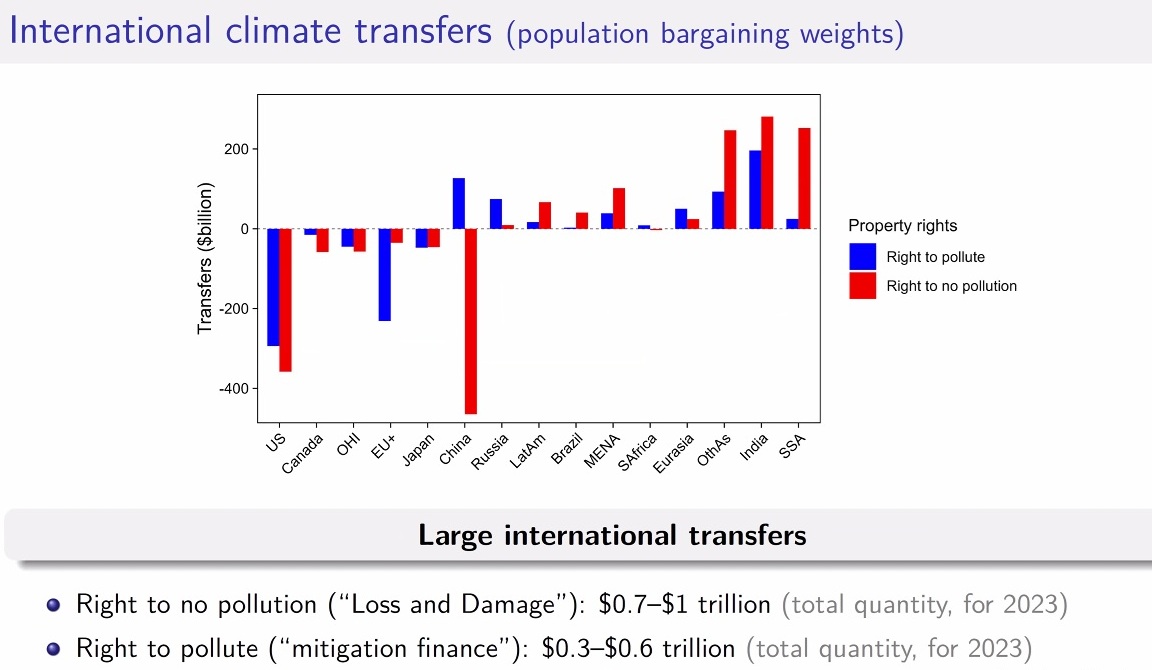
“Under the right to no pollution, transfers have a loss-and-damage flavor,” he noted.
“However, under the right to pollute, transfers have a mitigation finance flavor,” he said. “Countries that gain from emission reductions tend to compensate other countries with relatively larger abatement costs.”
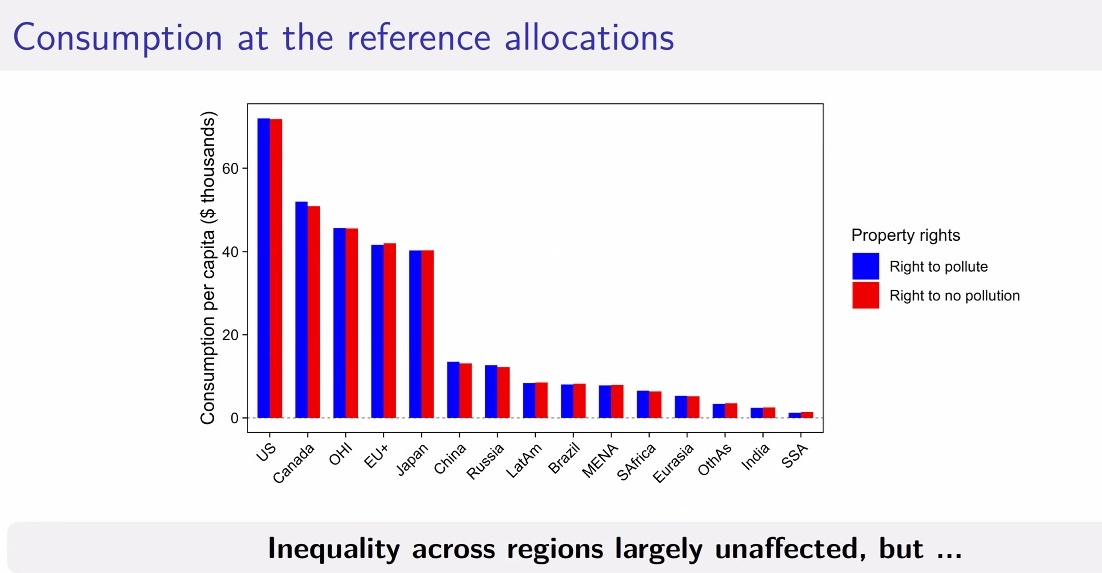
Consumption at the reference allocation showed inequality across regions was largely unaffected, as shown in the chart below (OHI = Oceania; SSA = Sub-Saharan Africa; MENA = Middle East & North Africa).
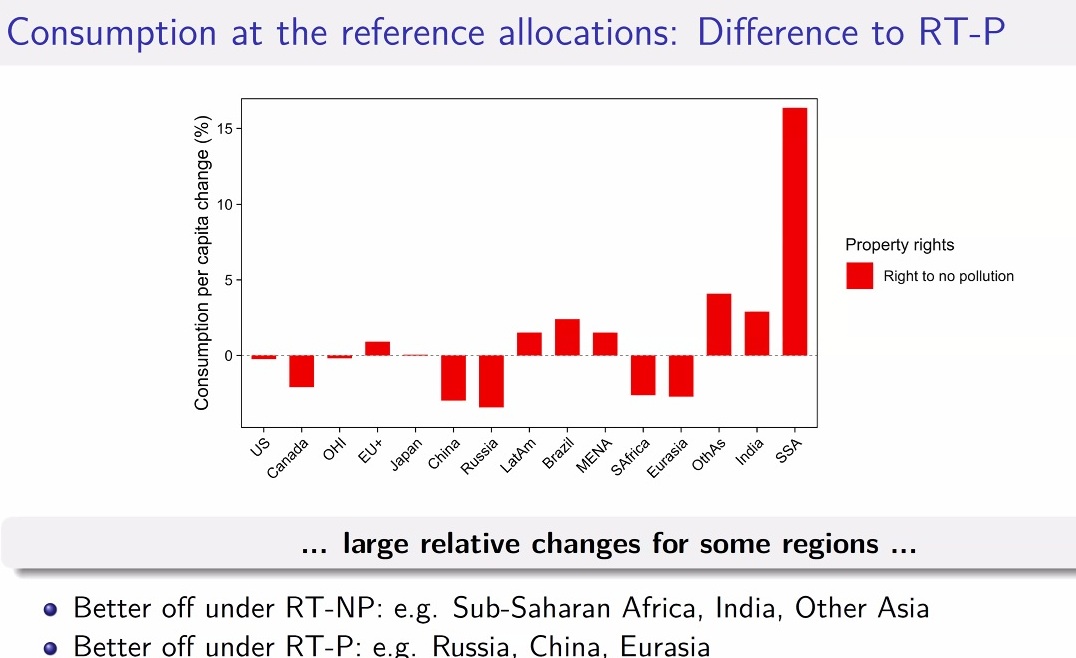
However, the relative consumption at the reference allocation showed large relative changes for some regions. The regions that are better off under the “right not to pollute” (RT-NP) are: Sub-Saharan Africa, India, and countries in Asia excluding India and China. Those that are better off under the “right to pollute” (RT-P) are Russia, China, and Europe. (See chart below.)
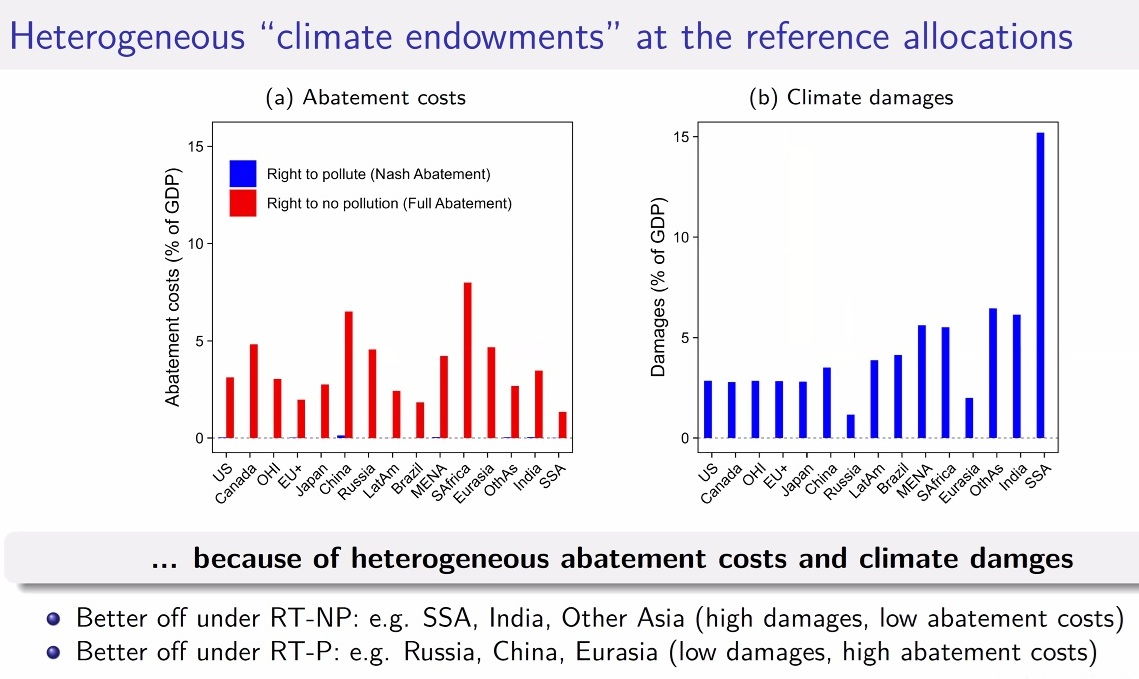
When the model included heterogeneous abatement costs and climate damages, the big picture remained the same. The regions that are better off under the “right not to pollute” (RT-NP) continued to be: Sub-Saharan Africa, India, and other countries in Asia. Those that are better off under the “right to pollute” (RT-P) continued to be Russia, China, and Europe. (See chart below.)
They studied some Pareto improvements relative to the reference allocations.
International climate transfers could be calculated according to GDP bargaining weights or population bargaining weights (see chart below). The estimated amounts are in trillions of dollars.
Lang showed the welfare weight differences relative to Negishi weights (chart below).
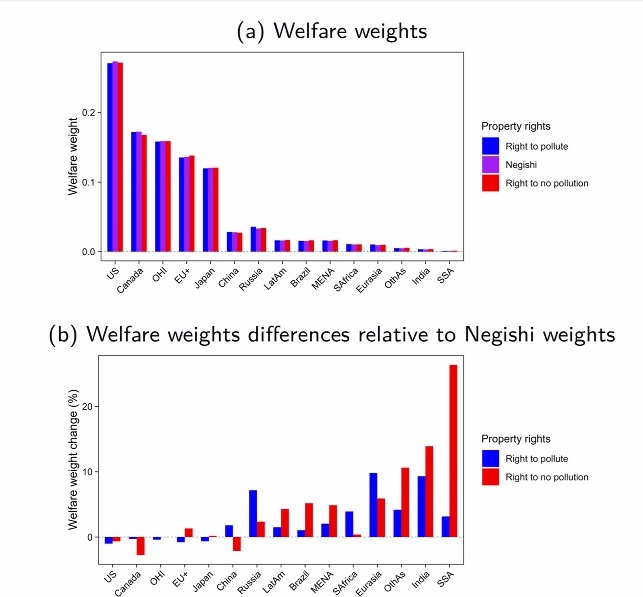
Qualitatively, the two treatments are broadly similar. Quantitatively, however, they are different.
“The key takeaway,” Lang noted, “is that different property rights regimes have large distributional effects.”
More information can be found in the research article by Lang, Kotchen and Gordon; the link to the abstract is given below. ♠️
The talk is based on the article, “Coase Meets Negishi: A Property Rights Rationale for Welfare Weights in Climate Economics.” Click here for the revised abstract.
Graphs are derived from webinar slides. Permission pending.
The thumbnail is from the Annenberg Learner. Permission pending.