

The global average temperature is on track to increase over 2026. A single glance at who can afford to own and run air conditioning shows how unevenly climate change affects the poorest households.
Or take a quick look at the recent BBC article on a heatwave in Banda, India.
Is it possible to address the inequality through good design of climate change policy?
“For a given global emissions reduction goal, the most efficient policy may not be the most equitable,” said Stéphane Zuber, Director of Research at CNRS, Paris School of Economics. He was presenting a webinar on April 16, 2026, as part of the Virtual Seminar on Climate Economics (VSCE), a series organized by the Europe-based Centre for Economic Policy Research (CEPR).
“Poorer countries have less financial means to mitigate and adapt to climate change,” said Zuber, “and within countries, the burden of mitigation may be borne disproportionately by poorer households, if climate policy is not carefully designed.”
“With the carbon tax, equity can be addressed through differentiating levels and trajectories of taxation,” Zuber said, “and also through using the carbon tax revenues to balance things out.”
According to Article 8 of the Paris Agreement, the policy must “recognize the importance of averting, minimizing, and addressing loss and damages associated with the adverse effects of climate change.”
“There are many questions remaining on the Loss and Damage policy,” Zuber said.
- What is the exact definition of loss and damage?
- How to address the financing needs?
- What are the details of the policy design such as who should fund it, and how?
- What is the attribution of resources?
Zuber and fellow researchers developed a global climate policy model that contains income inequality, climate damages, and mitigation costs at the subnational level.
The garden-variety Integrated Assessment Model typically aggregates countries and regions, and ignores the within-country inequality. He said, “It has a limited analysis of redistributive climate policies.”
Zuber used the Nested Inequalities Climate Economy model (NICE) based on the landmark 2015 paper by Nordhaus. The country-level disaggregation extends previous versions to 179 countries. The baseline growth rates are calibrated on shared socioeconomic pathway.
He used what is known as the FaIR Climate Emulator, a reduced-complexity climate model useful for scenario assessment and idealized climate runs. This has a “temperature anomaly downscaled to the country level and it includes a country-specific damage function.”
Within a given country, the inequality of the income distribution is divided into consumption deciles. The mitigation costs and climate damages are distributed across deciles, as well as the carbon tax burdens and revenue recycling.
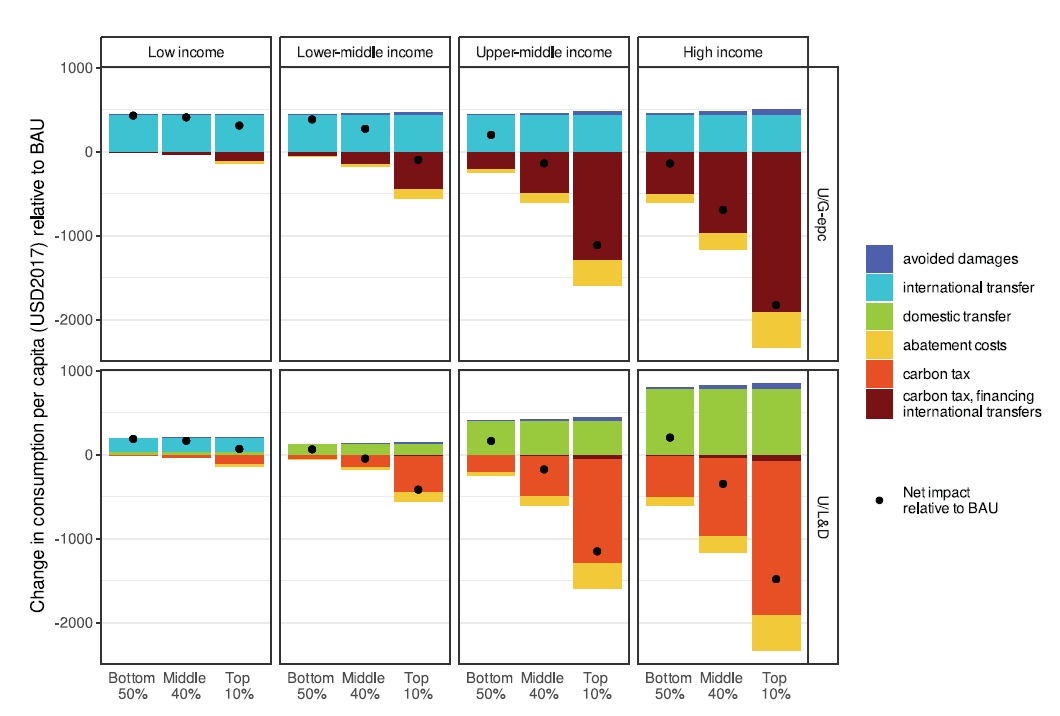
The composite figure below shows the change in consumption per capita, relative to BAU (business as usual), for different income levels. The components are colour-coded according to the source of the funds (international transfer, domestic transfer, abatement costs, and carbon tax). Details are available in the article.
Key findings
- Carbon taxation and redistribution improve general economic welfare and reduce inequality.
- The uniform taxation with global per capita redistribution policy is most effective, but requires large international transfers.
- A loss-and-damage policy based on taxation is a feasible compromise with strong welfare gains for the low-income countries.
- Differentiated taxes and domestic recycling are a robust alternative.
Zuber’s research shows that policymakers should
- Prioritize global per capita recycling if international cooperation is feasible.
- Implement loss and damage funds that would be funded by a carbon tax.
- Use differentiated taxes with domestic recycling if possibilities of international transfers are limited.
Zuber cautioned that a limitation of the model is that it assumes effective redistribution, which may be challenging in the least developed countries. Also, the bureaucratic costs of running the global funds have not been modelled. Other policy scenarios could, and should, be explored. ♠️
The graph is derived from the webinar slides. Permission pending.
Click here to view the research article “Within-country inequality and the shaping of a just global climate policy” at Proceedings at the National Academy of Sciences (PNAS) by Marie Young-Brun, Francis Dennig, Frank Errickson, Simon Feindt, Aurelie Mejean, and Stéphane Zuber.