
Origins of Canadian Banking
The financial crisis of 2007-2008 triggered a worldwide recession. The American and European banking systems experienced massive losses, takeovers, and taxpayer-funded bailouts. Lehman Brothers, Northern Rock, European debt crisis, … and the after-effects are still being felt. Canada’s banking system did have some shaky moments, as a recently published analysis of its asset-backed commercial paper (ABCP) predicament showed. On the whole, however, Canada’s banks withstood the financial crisis relatively well and the financial system maintained its liquidity, solvency, and profitability. The history of the divergence in the Canadian and American banking systems is recounted in a new book. From […]

Geopolitical Risk
What’s with Russia and cyber-hacking? How did it happen, and why? Geopolitical risk threatens the very fundamentals of market stability and the world order. The Global Association of Risk Professionals treated its members to a “big picture” risk topic during the webinar on November 1, 2017. Former senior US intelligence officer Jack Thomas Tomarchio, who is now a principal with the Agoge Group, LLC, described the current geopolitical risk due to Russian cyber-attacks. “Russia was declared to be responsible for leaks at the Democratic National Convention in 2016,” Tomarchio said. “The DNC is supposed to be neutral, but the leaks […]

“Worse Than Silverfish”
Some authors go to great lengths to make their monographs up-to-the-moment. In this excerpt, the authors refer to a popular and critically acclaimed TV series. It’s a calculated risk. They use an obsession of the (fictional) characters—the money they are amassing—to tie into the very real phenomenon of hyperinflation. Today’s excerpt comes from page 103 of the book The Evolution of Money by David Orrell and Roman Chlupaty (Columbia University Press, 2016). “To visualize how hyperinflation can affect one’s personal savings, fans of the TV show Breaking Bad will recall the episode in season 5 in which it is shown […]
Counterparty Credit Risk 2. The Good, the Bad, the Ugly, and the Unseen
“Data and its accuracy are key to making this work,” said Robert Scanlon, referring to counterparty credit risk. Scanlon is the former Group Chief Credit Officer of Standard Chartered Bank and current Principal, Scanlon Associates. As the second of three speakers at a GARP webinar on counterparty risk held on May 20, 2014, Scanlon spoke from years of experience with risk practices. First, the good part of calculating counterparty credit risk. Scanlon said there is plenty of data already, especially for consumer/retail transactions. “You can start with a steady state assumption and get more data as time goes on. Ask […]

China: Global Leader, Threat, or Both? Part 2.
“The likelihood of conflict is low but non-negligible” when it comes to China’s perspective on Japan’s re-militarization, said Daniel Wagner, CEO of Country Risk Solutions, during the second half of his Global Association of Risk Professionals webinar on October 22, 2013. After surveying Sino-American relations in Part 1, Wagner guided the audience through an in-depth look at China’s evolving geopolitical position in Asia and Africa. Japanese Prime Minister Shinzo Abe has raised military spending, loosened constitutional constraints on military action, and given a high profile to the Senkaku Islands dispute. Sabre-rattling occurs, but Wagner doubts that China and Japan would […]
China: Global Leader, Threat, or Both? Part 1. China and US
“Hide one’s brilliance, bide one’s time” seems the most fitting aphorism for China’s global strategy, said Daniel Wagner, CEO of Country Risk Solutions. During an hour-long webinar on October 22, 2013 organized by the Global Association of Risk Professionals, Wagner guided the audience through China’s evolving geopolitical position generally, as well as its relationships with US, Asia, and Africa. China is in the ascendant mode, said Wagner, citing the increasing use of the yuan as a reserve currency, as well as its rising military power. Regaining global dominance would be “like picking up where they left off,” he said, reminding […]
Modeling Sovereign Risk. Part 2: Quantification
“The Bloomberg sovereign risk model starts by dividing countries into two types,” said Rajan Singenellore, “reserve-currency countries and non-reserve currency countries. Everything else depends on that distinction.” Singenellore is Product Manager, Risk & Valuations at Bloomberg and was the second of two speakers to address a GARP webinar audience on September 12, 2013. A reserve-currency country is one whose currency is held in significant quantities by other governments as part of their foreign exchange reserves, such as the US and the Japan. There is a pressing need for quantification in the area of sovereign credit risk, he said, citing as […]
Modeling Sovereign Risk. Part 1: Emerging Markets
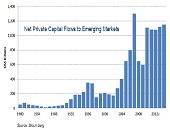
“Country-specific factors such as government debt and the sovereign credit rating change slowly but global aggregates such as the risk appetite change quickly, thus leading to confusion the part of observers,” said Michael Rosenberg, Foreign Exchange Consultant, Bloomberg and author of Currency Forecasting: A Guide to Fundamental and Technical Models of Exchange Rate Determination. He was the first of two speakers to address a GARP webinar audience on September 12, 2013. Much of Rosenberg’s talk focused on the sovereign credit risk of emerging markets (EM), because the accelerating flow of net private capital into EM from 1980-2014 has been unprecedented. […]
Foreign Asset Income Trusts
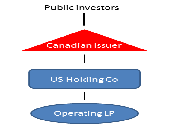
“Income trusts should be viewed as a story in capital markets innovation,” said Jon Northup of Goodmans LLP. He was speaking at a luncheon at the National Club in Toronto, sponsored by the Chartered Financial Analysts (CFA) Society Toronto on March 5, 2013. The introduction of SIFT (Specified Investment Flow-Through) rules by the Canadian government in October 2006, “effectively eliminated Canadian income trusts,” Northup said. There are two exceptions: (1) a trust that does not involve Canadian real estate, immovable or resource properties used in carrying on a business and (2) a trust that qualifies as a REIT (real estate […]
The Fed, Foreign Banks and Basel III: Part 1. A Long Hard Look
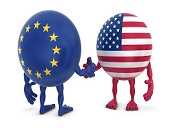
Foreign banking operations (FBOs) in the United States are about to face a whole new set of regulations that may dampen their enthusiasm for US-based operations, according to a February 14, 2013 webinar organized by the Global Association of Risk Professionals (GARP). “The Fed observed over time that US branches were increasingly used to fund the home office operations,” said Charles Horn, partner at Morrison Foerster, who was the first speaker at the panel. Other concerns of the Federal Reserve Board are the increased complexity of FBOs, and “the availability of home country financial resources for branch offices.” The goal, […]